GROUPTRAVELRES

BEYOND THE SPREADSHEET. One connected system.

How I transformed two decades of group-travel operations into a connected booking and financial workflow.

Role
Full-stack Product Engineer
Year
2017–2018
Scope
Systems Design, UX/UI, Full-stack Engineering
Platform
Web Application · Operations Dashboard
(01)

The constraint

Twenty years of operations, held together by spreadsheets.

For decades, group travel reservations were managed through an intricate collection of spreadsheets, bank statements, manually maintained notes, and disconnected processes.

Each reservation carried multiple moving parts: several travelers, staggered payment schedules, partial deposits, signed contracts, insurance decisions, and open balances.

The people running the business understood how these pieces fit together. Much of that knowledge lived in the spreadsheets themselves—in their structure, formulas, annotations, and established ways of working. Yet the information was scattered: knowing the real status of one reservation meant reconciling records across multiple tabs and files.

Over twenty years, the spreadsheet had quietly become the operating system of the business.

VISUAL 01 · THE ORIGINAL CONSTRAINT ONE BOOKING · INFORMATION EVERYWHERE
TRIP SPREADSHEETS BOOKING AND TRAVELER RECORDS BANK STATEMENTS RECEIVED PAYMENTS & WIRES PAYMENT SCHEDULES DEPOSITS AND BALANCES DUE CELL NOTES & EMAILS EXCEPTIONS AND FOLLOW-UP WHAT IS THE ACTUAL STATE OF THIS RESERVATION? REQUIRES HUMAN RECONCILIATION ACROSS SEVERAL DISCONNECTED SOURCES
RECONSTRUCTION · ANNOTATED LEGACY WORKBOOK HOW TACIT RULES LIVED IN CELLS
Traveler
Room / Grouping
Deposit / Paid
Insurance Status
Staff Cell Note
Ana K. + Lea M.
Twin · Room #4
50% paid (bank)
Trip policy #882
—
Marko T.
Twin · w/ Ivan?
Partial · check wire
rider? ask email
Confirm 2nd half May
Sara B.
Single supplement
Paid in full
Own policy PDF
Ready
Simplified reconstruction with illustrative names and entries showing how room pairings, split deposits, and insurance compliance depended on freeform text comments.
(02)

Domain discovery

First, map what the spreadsheets actually represented.

Rebuilding the existing workflow as an online table would have preserved many of its limitations. The deeper task was uncovering the underlying operational relationships:

  • Reservation boundary: What exactly constituted a reservation across a multi-day departure?
  • Group geometry: How did individual travelers relate to a shared rooming or booking group?
  • Financial truth: How were scheduled payment obligations different from money actually received?
  • Readiness gates: How did insurance coverage and signed contracts determine whether a booking could depart?

We needed to distinguish enduring business rules from the manual workarounds people had invented to keep things running.

The design challenge was to turn decades of accumulated operational knowledge into an explicit, coherent product model.
VISUAL 02A · DOMAIN DISCOVERY MAPPING CELL SHORTHAND → EXPLICIT ENTITIES
CELL NOTE “TWIN · W/ IVAN?” BOOKING GROUP & ROOMING ENFORCED TWIN / TRIPLE / QUAD OCCUPANCY BANK NOTE “50% PAID · CHECK BANK” OBLIGATIONS ⇄ TRANSACTIONS SEPARATE WHAT IS DUE FROM MONEY RECEIVED EMAIL THREAD “ASKED BY EMAIL · PENDING” CONTRACTS & PARTICIPANT INTAKE REQUIRED RECORDS TIED TO RESERVATION POLICY NOTE “RIDER? ASK BEFORE TRIP” INSURANCE POLICY VERIFICATION AUTOMATED COVER SELECTION & PROOF
Rather than replicating manual comment strings online, each operational habit became an explicit state on the reservation record.
(03)

The Ledger

The breakthrough: One Reservation Ledger.

The central idea was to treat the reservation as a shared operational record rather than an isolated spreadsheet row. A reservation connected the people traveling, what they had booked, what they owed, what they had paid, and which obligations remained unresolved.

From that model, we organized operations around seven explicit domain concepts: Trip · Reservation · Passengers · Payment obligations · Transactions · Contracts · Insurance.

One particularly important distinction was separating money expected from money received. A payment schedule represented what a traveler owed and when; a transaction recorded money that had actually arrived. Relating the two made financial status immediately legible without manual spreadsheet reconciliation.

One reservation. One connected account of what happened, what’s owed, and what comes next.

VISUAL 02B · THE RESERVATION LEDGER ONE SOURCE OF TRUTH
RESERVATION The shared operational record across travelers and agency staff PASSENGERS TRAVELERS & INTAKE PROFILES TRIP & BOOKING DATES, CAPACITY & ROOMING CONTRACTS & INSURANCE AGREEMENTS & COVERAGE GATES PAYMENT OBLIGATIONS SCHEDULED DEPOSITS & DUE MILESTONES ⇄ TRANSACTIONS MONEY ACTUALLY RECEIVED · CARD / WIRE
Domain model separating scheduled payment obligations from recorded card and wire transactions.
(04)

Three interfaces

One model, three connected experiences.

The same underlying reservation system needed to serve three distinct roles without duplicating data entry:

01 · Public trip What can I book?

Destinations, itinerary, pace, included amenities, and live spot pricing without manual page upkeep.

02 · Traveler flow What must I finish?

Register passengers, choose rooms, confirm insurance decisions, and manage installment payments.

03 · Agency ops What needs attention?

Publish trips, monitor collected balances vs upcoming milestones, and catch missing policies fast.

Three different experiences. One underlying system of record.

VISUAL 03 · ONE SYSTEM · THREE INTERFACES ROLE-SPECIFIC INFORMATION ARCHITECTURE
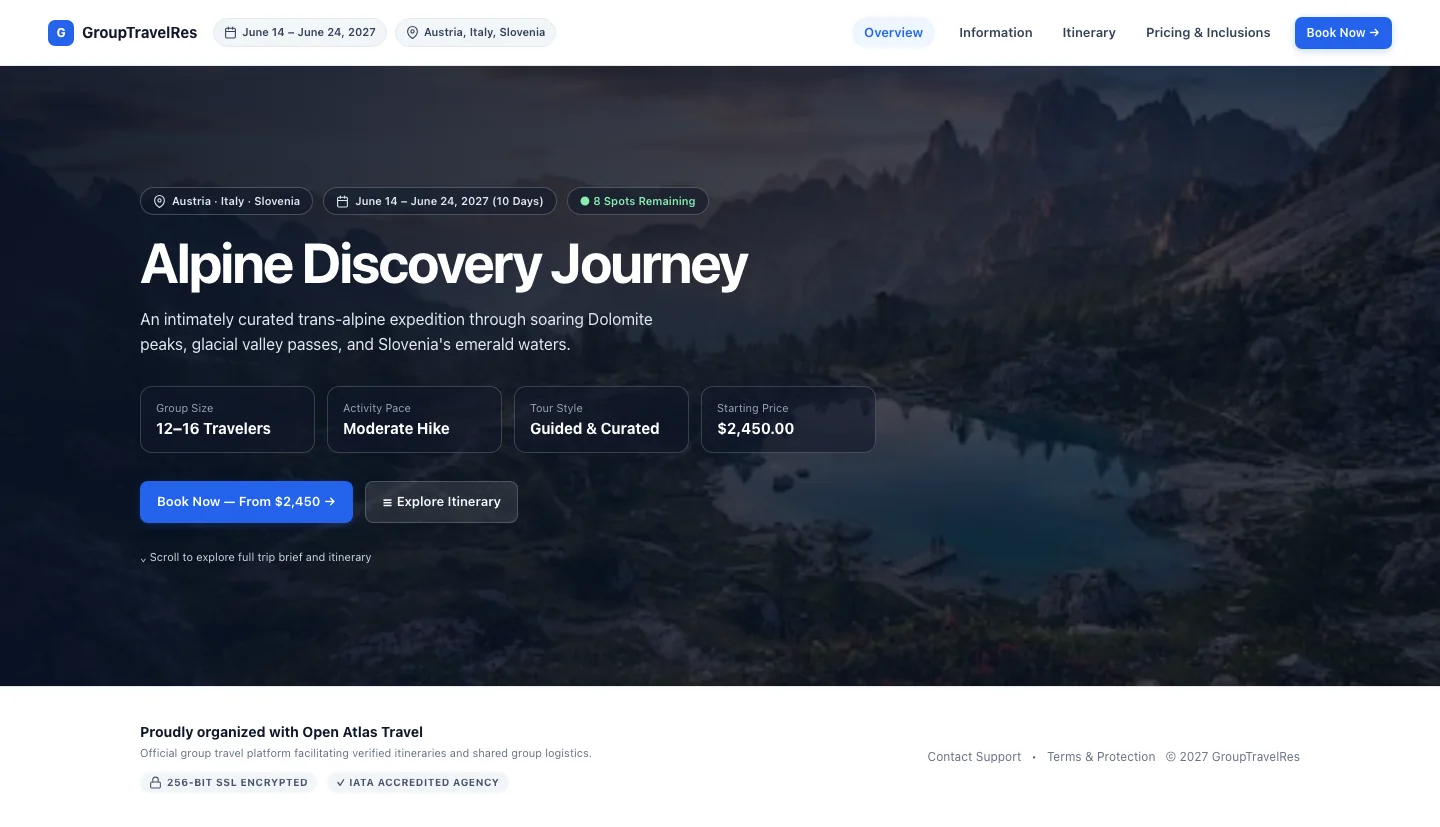
01 · PROSPECTIVE TRAVELER Trip Microsite “What can I book?”
Public GroupTravelRes trip page for Alpine Discovery Journey showing group size, moderate hike pace, and $2,450 starting price
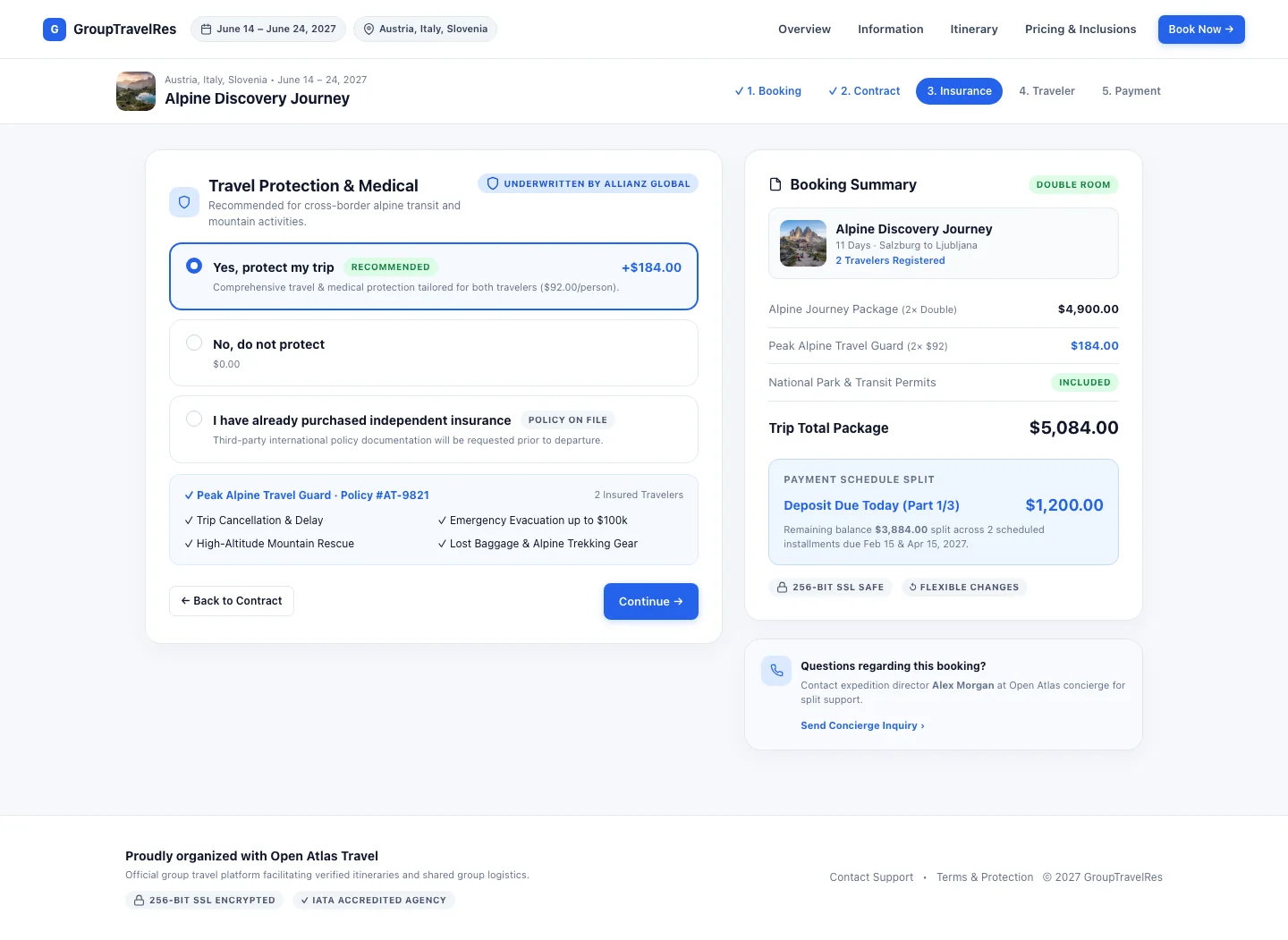
02 · BOOKED TRAVELER Traveler Booking “What must I complete?”
Traveler Booking Step 3 Travel Protection and Medical with Booking Summary showing $5,084 total and $1,200 deposit due today
03 · TRAVEL AGENCY / OPERATOR Agency Workspace “What needs attention?”
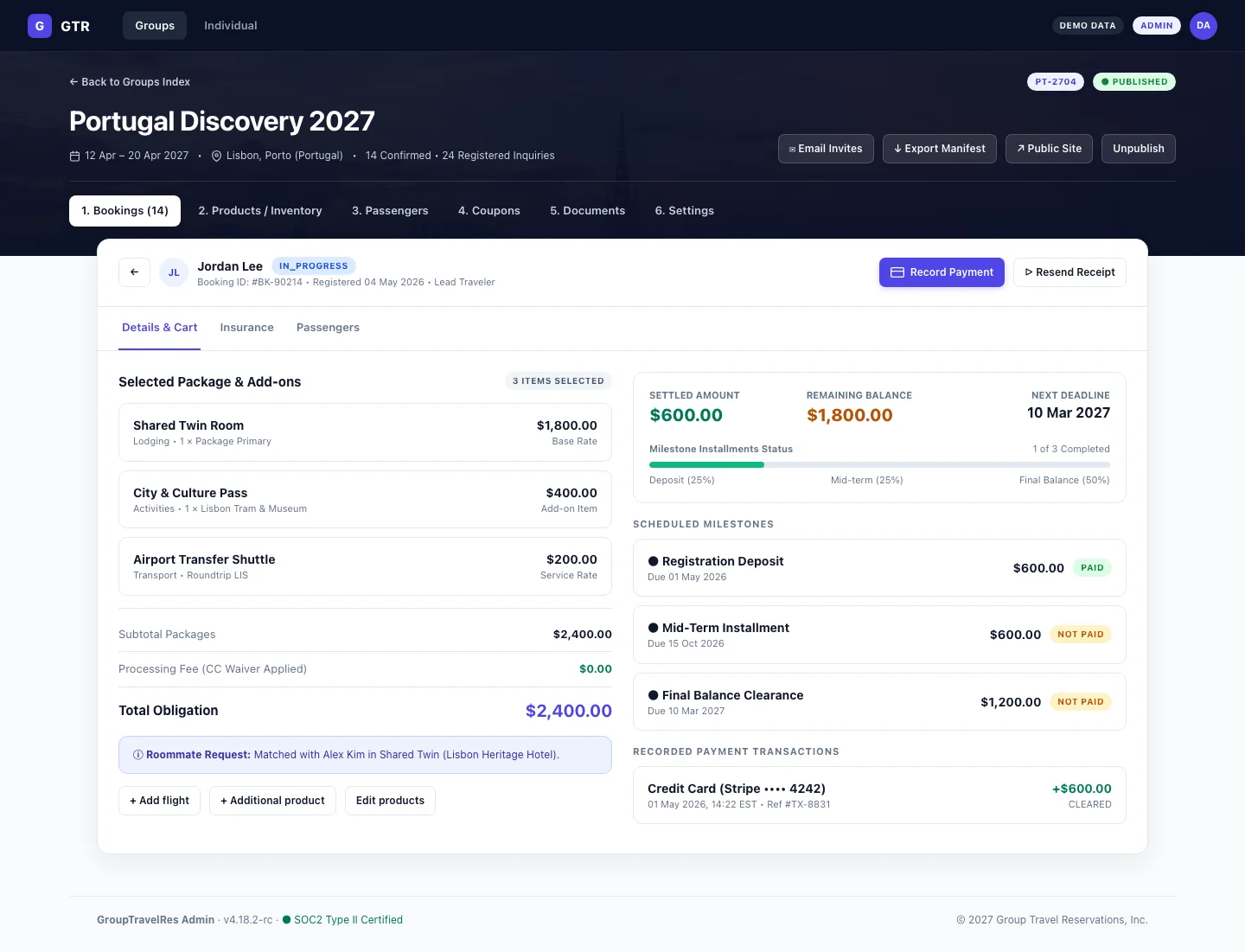
GroupTravelRes Agency Workspace for Booking #BK-90214 separating $2,400 Total Obligation from $600 settled Stripe receipts
SHARED RESERVATION DATA Public trip page, 5-step traveler checkout, and agency workspace read directly from one underlying model.
Hi-res UI screens recreated from the 2017–2018 system architecture using illustrative trips, travelers, and balances across all three role views.
(05)

Payments

Making complex payment operations understandable.

Group travel involves more than a single purchase. Travelers may pay deposits, split installments across time, send wire transfers, or carry outstanding balances.

Because obligations and transactions remained separate records, the reservation could always surface exact financial state—unpaid, partially paid, pending, late, or paid—alongside contract and insurance compliance in the same view.

VISUAL 04 · ONE OBLIGATION, CHANGING FINANCIAL STATE INTERACTIVE STATE EXPLORER
BOOKING #BK-90214 · SCHEDULED OBLIGATION PARTIALLY PAID
$1,200
37.5% SETTLED ACROSS RECORDED TRANSACTIONS
RECEIVED (TRANSACTIONS) $450
REMAINING (OBLIGATION) $750
Ledger stateA transaction of $450 has been recorded against the scheduled $1,200 deposit obligation.
Operator actionTrack balance milestone; send installment reminder link before departure cutoff.
Readiness gateContract signed · Insurance verification visible beside remaining balance.
Illustrative financial figures demonstrating the relationship between recorded transactions, remaining obligations, and available operator actions.
(06)

Working software

Turning the model into full-stack working software.

My work extended from business modeling into designing and engineering the full-stack application connecting traveler booking flows, passenger intake, scheduled payments, Stripe checkout, and travel insurance verification.

The core craft challenge was matching fidelity to each role: travelers saw a clear step-by-step path, while agency staff inspected dense financial milestones and exceptions on the exact same records underneath.

One coherent model, expressed through interfaces appropriate to each person’s work.

STEP 01 / 05 · PUBLIC TRIP MICROSITE
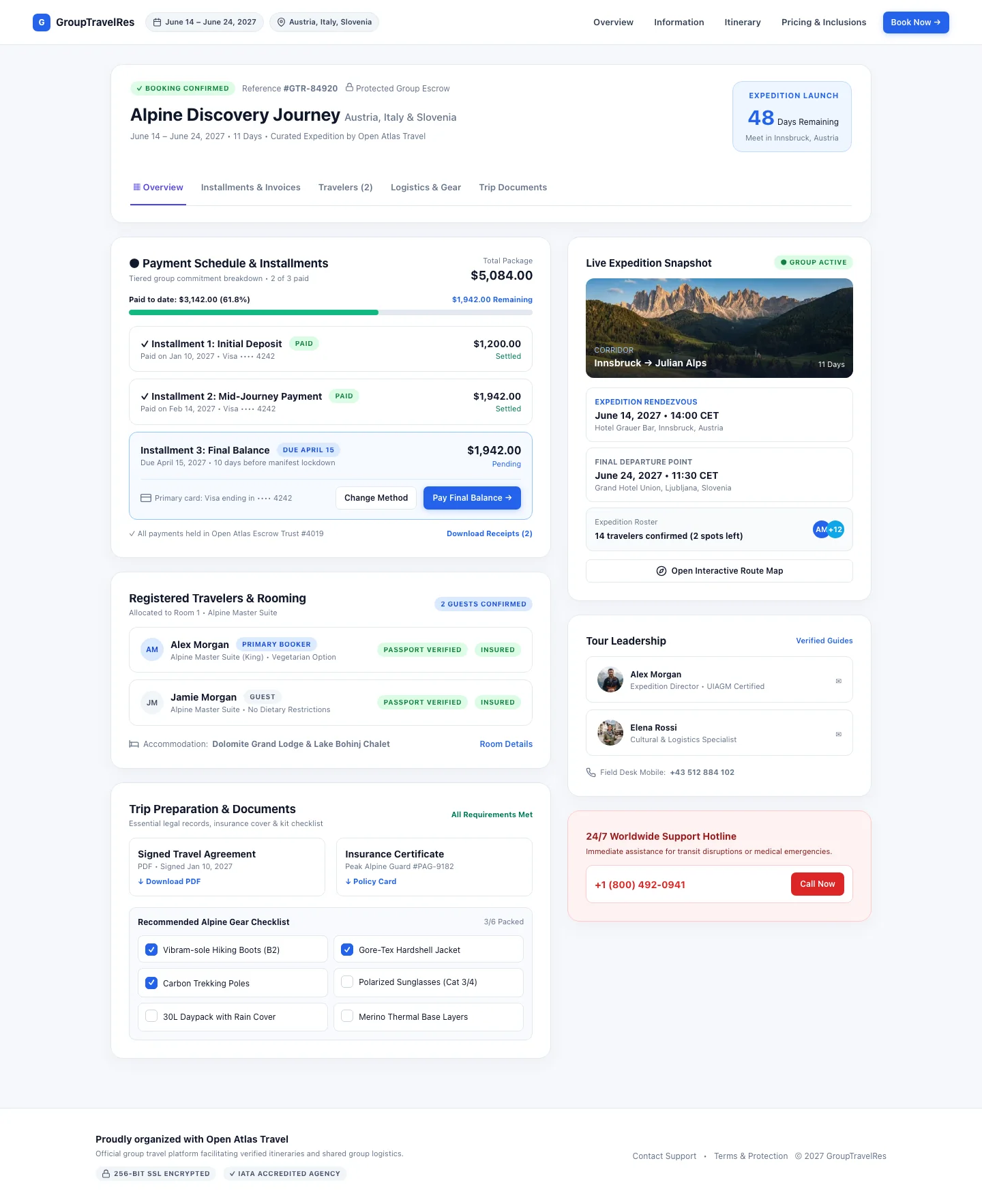
Booked Traveler Hub #GTR-84920 showing paid installments ($3,142), registered travelers Alex & Jamie Morgan, and signed agreement PDF
Booked Traveler Hub (#GTR-84920) Paid & pending installments, rooming verification, and signed compliance docs
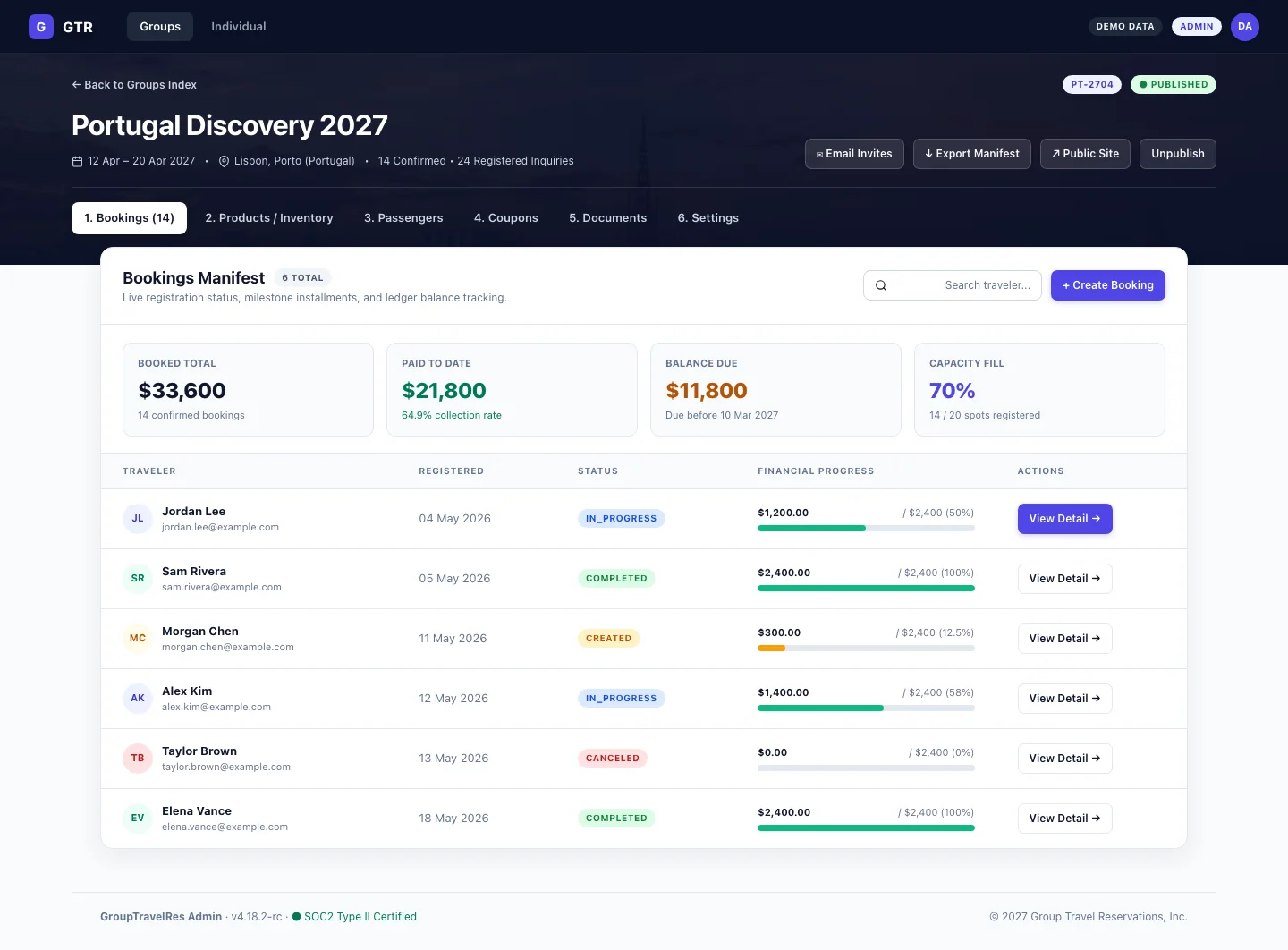
Agency Bookings Manifest displaying $33,600 Booked Total, $21,800 Paid to Date, and traveler payment bars
Agency Bookings Manifest Group financial rollups ($33,600 booked · $21,800 paid · 70% fill) across all travelers

Hi-res UI screens recreated from my 2017–2018 domain model using illustrative trips, travelers, and balances.

Engineering Note · Financial State Integrity Why Obligations & Transactions Stayed Separate
Separating Scheduled Milestones From Incoming Webhooks
The Failure Mode Avoided

Storing a single mutable amountPaid integer fails as soon as a guest splits payments with a roommate, sends a wire transfer, or triggers a partial refund.

The Implementation Rule

Keeping append-only Transactions linked to PaymentSchedule obligations let Stripe webhooks, bank verifications, and organizer adjustments reconcile cleanly.

(07)

Transformation

From manual operations to a connected booking platform.

The resulting platform replaced Alpine Adventures’ fragmented spreadsheet workbooks with connected operations. Reservations, passenger intake, milestone payments, and insurance compliance ran on one shared system—supporting more than $1M in annual gross trip bookings.

Just as important was the structural shift: instead of depending on implicit knowledge spread across separate documents, the business ran on an explicit domain model connecting everything required to prepare a departure.

VISUAL 05 · THE TRANSFORMATION MANUAL WORKBOOKS → CONNECTED PLATFORM
$1M+ Annual gross trip bookings handled by the software
COMMERCIAL VOLUME SUPPORTED
BEFORE · FRAGMENTED OPERATIONS
MULTI-TAB CHAOS

Per-trip Excel tabs, bank statement lookups, insurance chased over email, and rooming pairings trapped in cell comments.

AFTER · ONE CONNECTED LEDGER
ONE SYSTEM OF RECORD

Shared Reservation connecting Trip, Passengers, Scheduled Obligations, Received Transactions, Contracts, and Insurance.

$1M+ reflects annual gross trip booking volume processed through the connected platform after launch.
(08)

What I took

What GroupTravelRes reinforced for how I work.

Most "complex UI" problems clear up once the hidden relationships in the data model become explicit.

Alpine Adventures’ legacy spreadsheets held twenty years of real operational edge cases—roommate splits, wire delays, last-minute insurance swaps. Modeling obligations separately from recorded Stripe and bank transactions turned those edge cases from manual cleanup into predictable ledger states across both traveler and operator views.

Collaborators
Alpine Adventures operations & leadership team
Timeline
2017–2018
My Contribution
Domain Modeling, Information Architecture, Booking Workflows, Financial Operations, Interface Design, Application Development