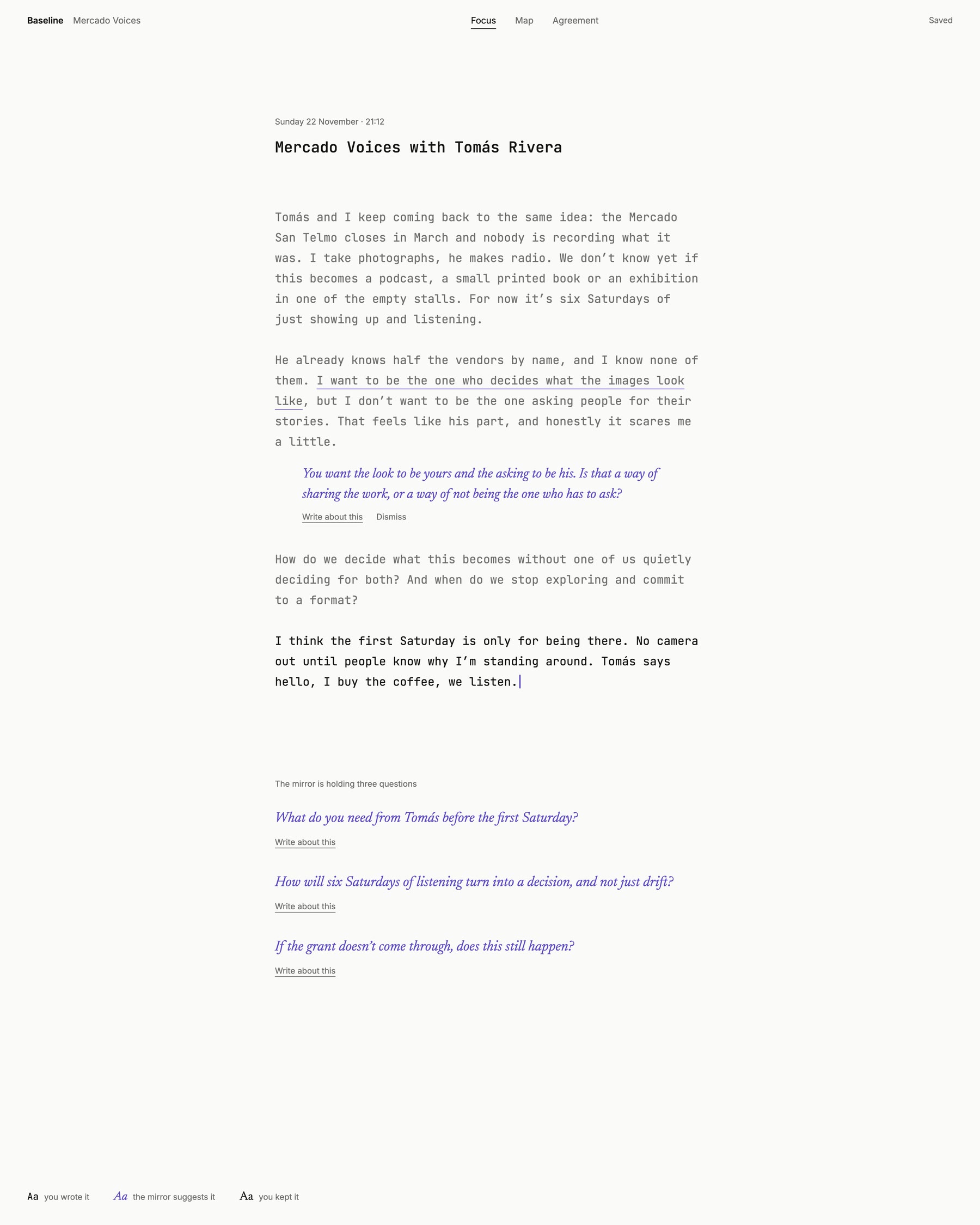
Writing helps us think
Writing helps us think. Keeping track of what emerges is harder.
We write to work through situations that are still unclear. A single journal entry often mixes half-formed ideas, unspoken boundaries, assumptions, and decisions we are not ready to make. Over weeks, those fragments start colliding: something written last month contradicts what happened today, or three separate notes point to the same underlying tension.
Chronological notebooks hide those cross-entry links. Handing the whole journal to a chatbot creates the opposite failure: its polished summary quietly replaces your own framing.
Baseline tests whether you can keep the low-pressure freedom of a notebook while letting structure surface beside your words.

The design question
How can AI participate without taking over?
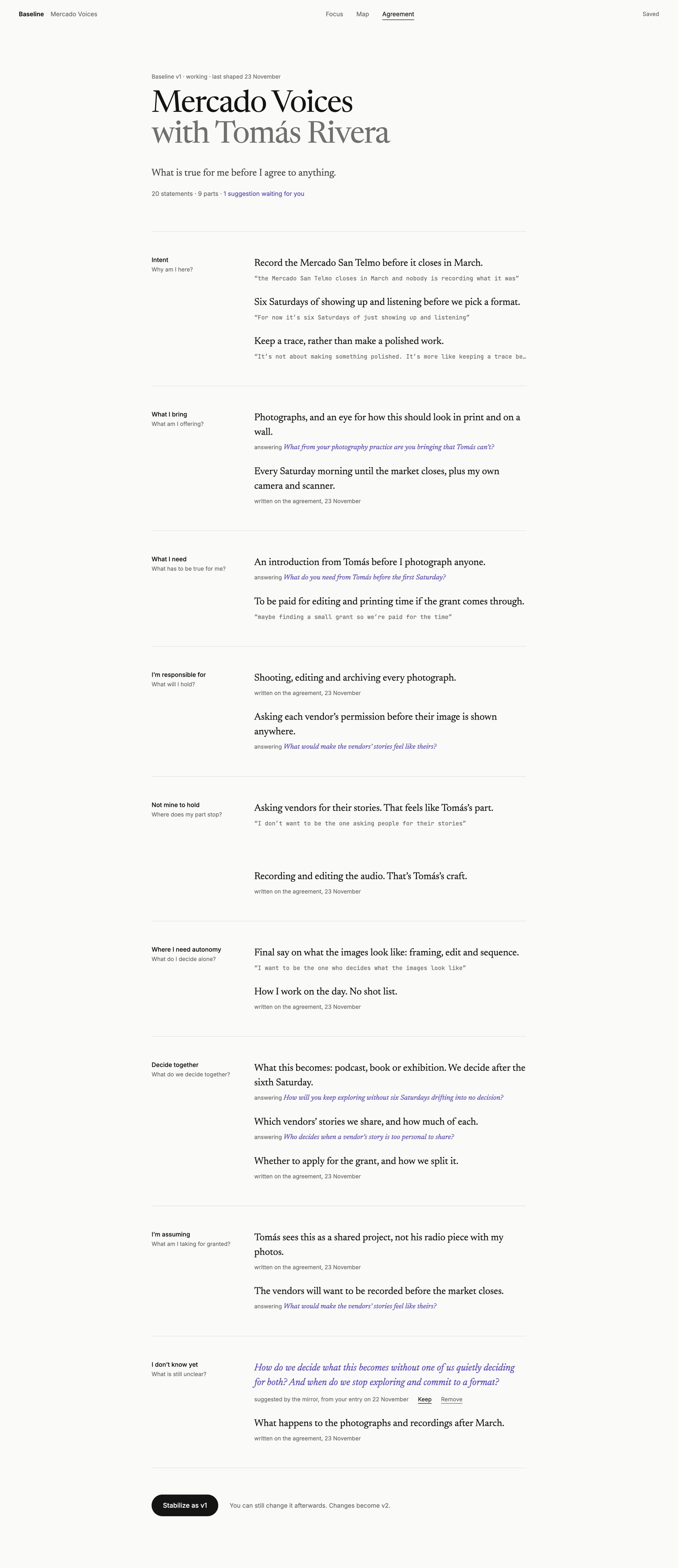
Baseline started as a tool for tracking explicit agreements over time, then moved upstream to a harder question: how does a clear position form out of messy notes in the first place?
A language model can spot recurring concerns or contradictions across entries, yet a plausible reading is often slightly off—or premature. I designed the interaction around a strict split of roles:
The human expresses. The AI interprets. The human decides. The software remembers.

The breakthrough
The journal stays the entry point.
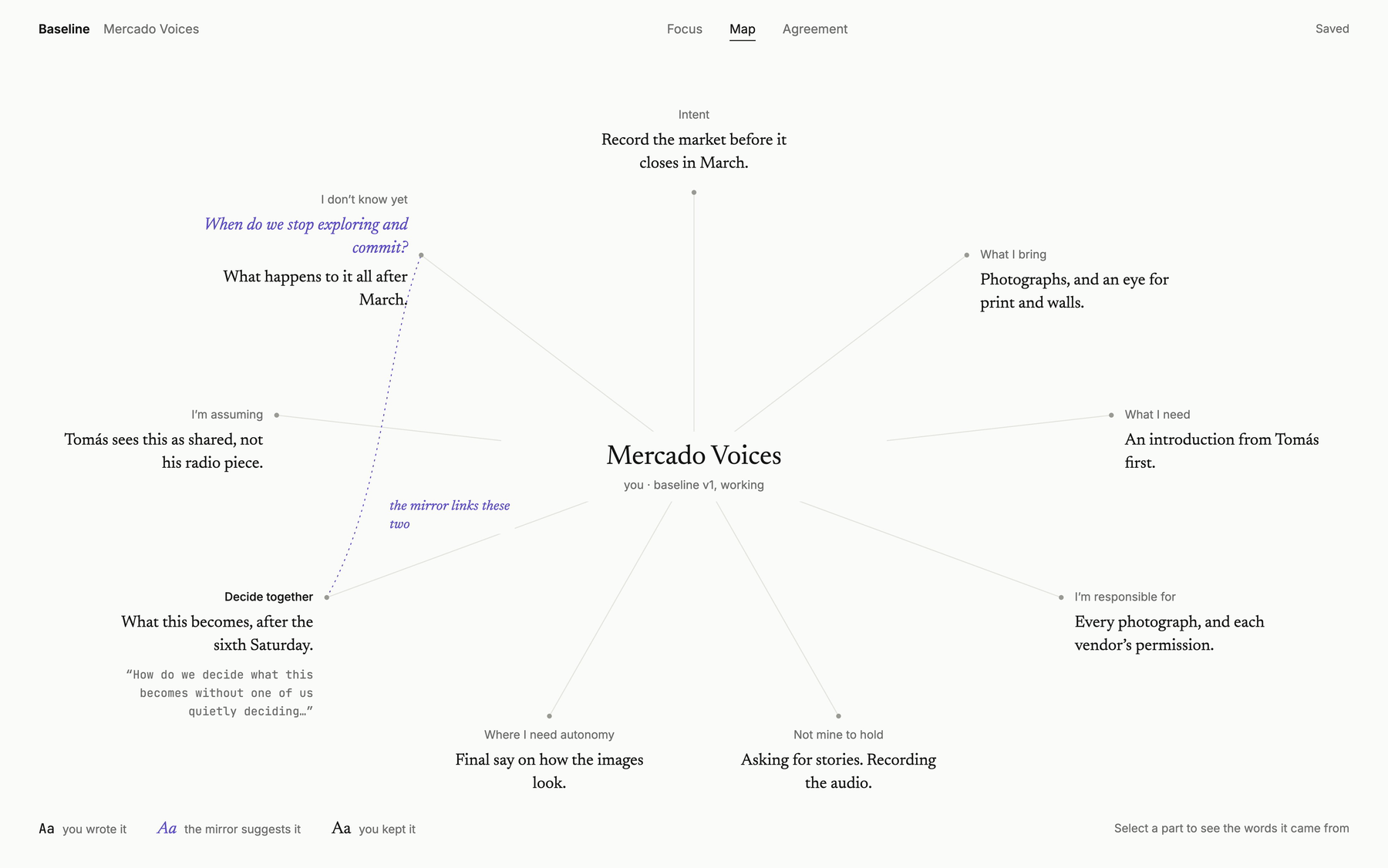
Writing in Focus carries zero upfront structure. From those raw entries, Baseline proposes a spatial map across nine dimensions: intent, what you bring, needs, boundaries, autonomy, joint decisions, assumptions, and open unknowns.
In the Mercado Voices prototype, a passage about a creative collaboration surfaces a tension between wanting freedom to explore and needing clearer commitments. You can trace that suggestion back to the exact sentence, rewrite it, keep it, or dismiss it—the map stays linked to the journal rather than replacing it.