BOXSPOT

SIX STEPS. One pre-cleared flow.

How we transformed a fragmented gym drop-in journey into one booking athletes and gym owners could trust.

Role
Co-founder · CTO · Product Designer & Engineer
Year
2019–2020
Scope
Product Design, Service Design, Engineering
Platform
iOS · Web Application
(01)

The friction

Want to work out? First, navigate six disconnected steps.

Imagine arriving in a new city and wanting to join a CrossFit class the following morning. You find a gym, check whether it accepts visiting athletes, figure out when a class is happening, contact the gym, complete a liability waiver, arrange payment, and confirm that somebody is expecting you.

The old process involved six distinct activities across emails, phone calls, paper forms, and conversations at the front desk:

  1. 01
    Find a gymCheck neighborhoods, affiliations, and whether the box welcomes visitors.
  2. 02
    Find a class timeCross-reference class schedules against your travel itinerary.
  3. 03
    Complete a waiverWait to fill out a liability form on paper at the front desk.
  4. 04
    Explain who you areExchange emails or introduce yourself to a coach before warm-up starts.
  5. 05
    PayHand over a credit card at the counter in between member check-ins.
  6. 06
    Confirm the bookingVerify in person that space actually remained in that class.

For athletes, the friction made something spontaneous feel unnecessarily complicated. For gyms, every visiting athlete introduced additional administrative work.

How could we make dropping into an unfamiliar gym as easy as booking a class on your phone—without adding work for the people running it?

VISUAL 01 · BEFORE / AFTER SERVICE JOURNEY SIX STEPS → DROP-IN PASS
01 FIND A GYM 02 FIND A CLASS 03 SIGN WAIVER 04 IDENTIFY YOURSELF 05 PAY 06 CONFIRM CONNECTED INTO ONE BOOKING EXPERIENCE BOXSPOT · ATHLETE PASS & GYM SYNC DROP-IN PASS LIVE ROSTER RECORD SYNCHRONIZED → ✓ Class reserved ✓ Waiver signed ✓ Payment complete ✓ Expecting arrival
Six operational requirements handled through one connected booking flow—reducing the athlete’s hand-offs without adding work for the gym staff.
(02)

Two-sided model

The challenge was bigger than booking a class.

BOXSPOT was a two-sided marketplace, so designing for the visiting athlete meant designing just as carefully for the gym’s capacity, daily schedule, payment requirements, and check-in procedures.

A booking could feel quick to an athlete while still dumping manual verification on the front desk—or appear confirmed in an app while the gym lacked the signed waiver required to let them train.

The experience could only succeed when both sides shared the same understanding of a reservation.
VISUAL 02 · TWO-SIDED SERVICE MODEL TWO EXPERIENCES · ONE SHARED BOOKING
ATHLETE EXPERIENCE 01Discover nearby gyms 02Choose an available class 03Sign waiver & pay in checkout 04Receive Drop-In Pass GYM OWNER OPERATIONS 01Publish daily schedule 02Set class capacity & rate 03See incoming booking on roster 04Check in pre-cleared athlete SHARED BOOKING One reservation connects the athlete’s confirmation directly to the gym’s operational records.
Designing the Shared Booking object made the relationship between consumer discovery and owner operations explicit before any UI polish began.
(03)

Lived experience

From lived experience to a product direction.

We began with a month-long design sprint. The founding team brought deep domain experience as CrossFit athletes and gym owners, and we used that firsthand perspective to map the existing journey, define the marketplace opportunity, and shape the product roadmap.

I helped translate those service requirements into a coherent product model and interface flows. The guiding constraint was simple: remove the friction athletes experienced without transferring that operational burden onto gym staff.

That required us to think beyond individual screens. We had to design the relationship between class availability, reservations, liability compliance, payment, and physical arrival.

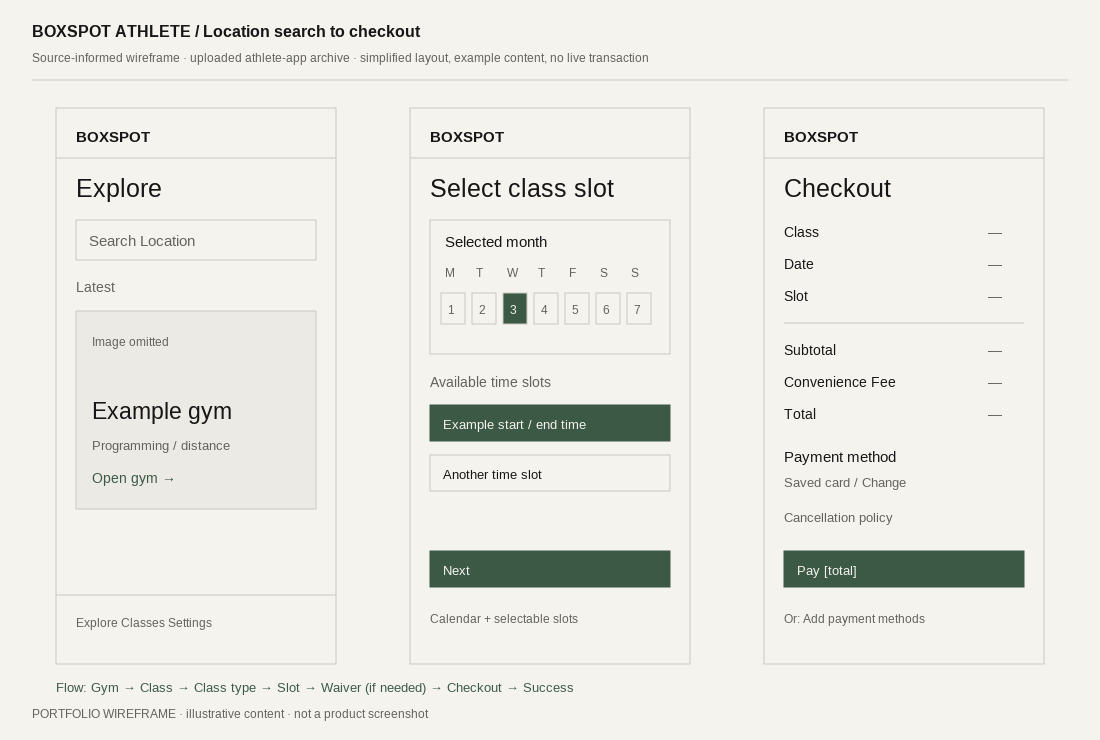
ARCHITECTURE ARTIFACT · ATHLETE BOOKING WIREFRAME GENERATED FROM BOXSPOT.APP.ATHLETE V1.1.0
Source-informed wireframe of the BOXSPOT athlete flow: Explore gym search, Select class slot calendar, and Checkout with waiver and payment
Structural wireframe reconstructed from the boxspot.app.athlete v1.1.0 codebase, mapping location search, class calendar selection, and waiver-aware checkout.
(04)

The breakthrough

Move the waiver into the booking—but only when necessary.

The liability waiver was a small operational detail with enormous consequences for the experience. Every visiting athlete needed one, yet signing it on a clipboard at the gym created a bottleneck at the exact moment athletes wanted to warm up.

We evaluated three architectural options before locking the checkout contract. Rather than forcing repeat visitors through redundant paperwork every trip, conditional execution made a confirmed booking far stronger for both sides.

Booked now meant: a known athlete, a signed waiver, a paid class, and an available spot.

VISUAL 03 · THE DESIGN DECISION — WHERE SHOULD THE WAIVER LIVE? EXPLORE THREE ALTERNATIVES
Conditional in checkout SELECTED ARCHITECTURE
The experienceFirst-time visitors complete the digital waiver during mobile checkout; returning athletes skip straight to payment.
The trade-offCheckout logic branches conditionally using an explicit guard on prior waiver signatures rather than one static form.
The consequenceGyms receive a legally cleared arrival every single time while frequent travelers enjoy zero repeated paperwork.
Pick class → 1st visit: Sign waiver / Repeat: Waiver skipped → Pay & Confirm
Click each tab to inspect how placing the waiver in software directly reshaped both front-desk workload and repeat athlete UX.
(05)

The experience

One booking, three connected interfaces.

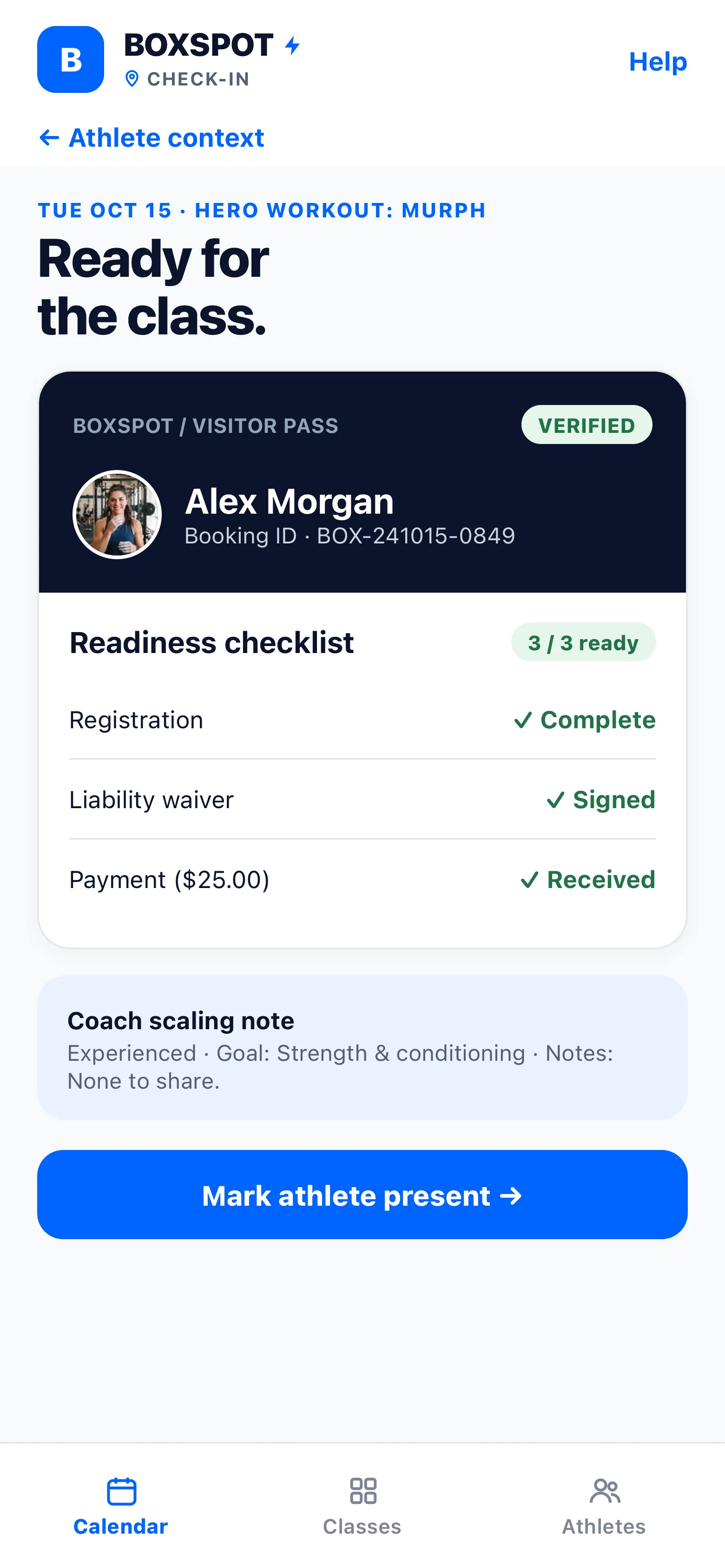
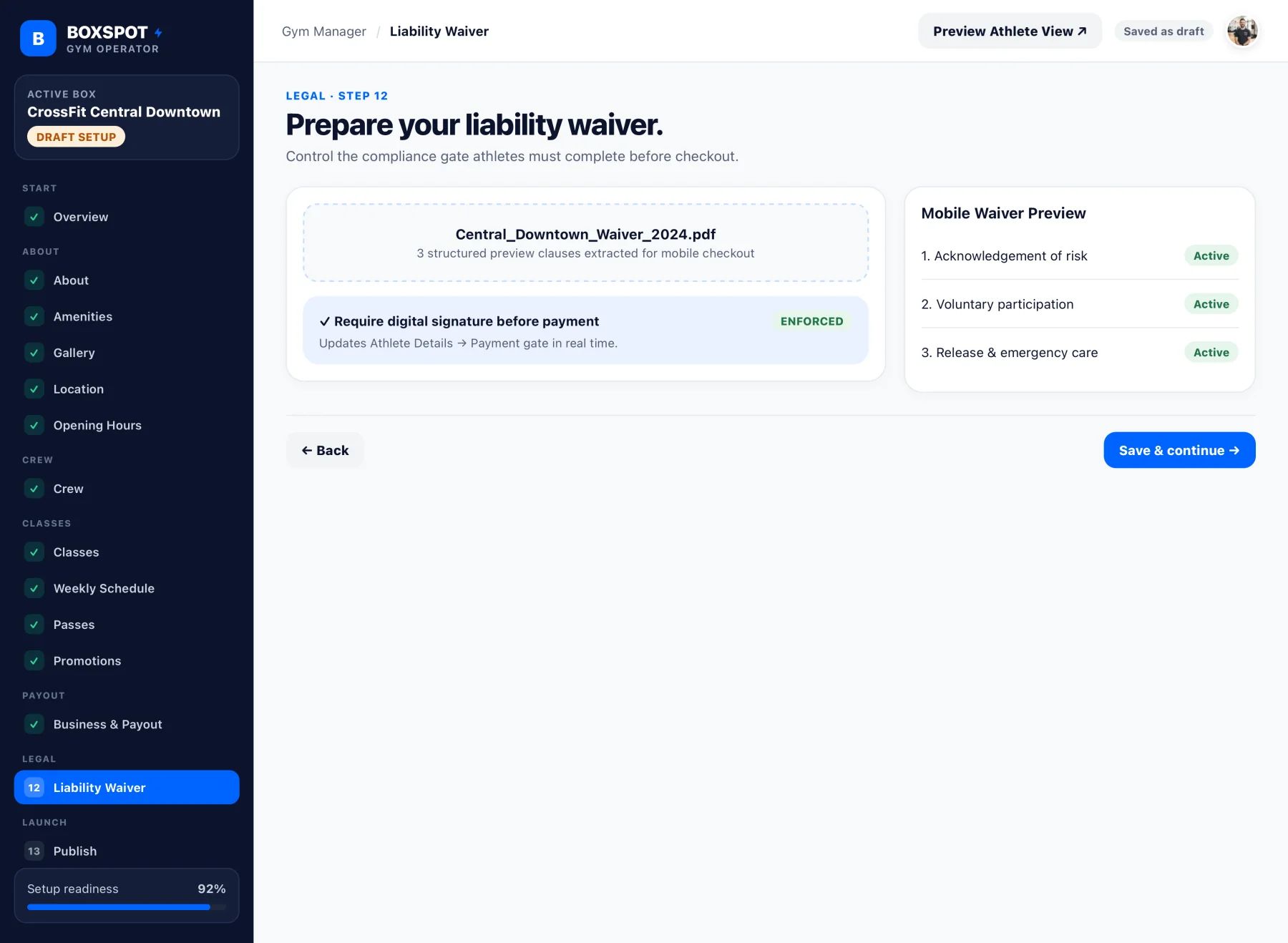
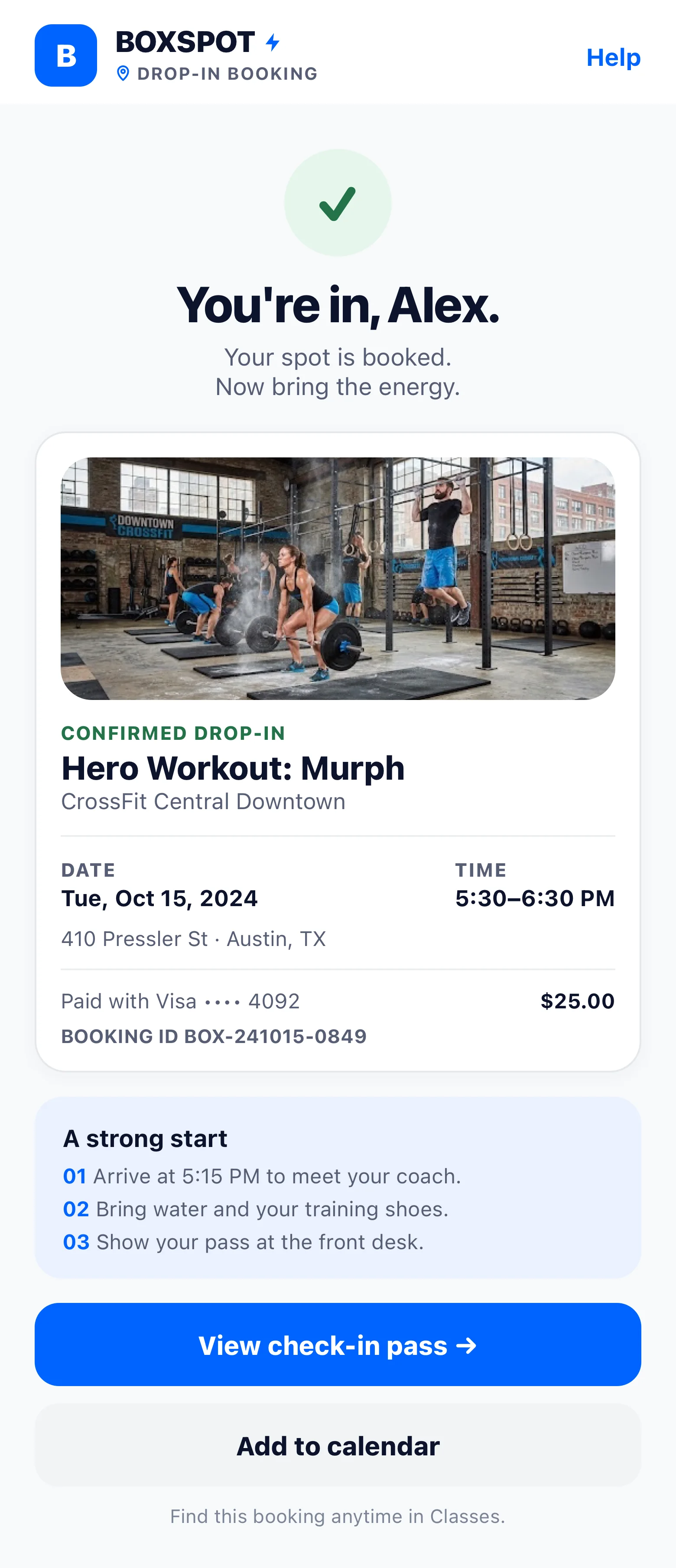
An athlete discovers nearby boxes, picks a class with open spots, signs the gym’s waiver once inside checkout, and receives a verified QR pass. In parallel, the gym owner sees Alex Morgan pre-cleared in that class’s live roster, fed directly by class inventory, weekly schedules, and enforced waiver rules configured in the Operator Web console.

Athlete MobileExplore Austin boxes → Choose Hero Workout: Murph → Sign waiver & pay $25 → Present QR pass
Owner MobileMorning calendar → Live Murph roster (10/14) → Readiness checklist (3 / 3) → Mark present
Operator WebDefine drop-in classes ($25.00) → Publish weekly slots → Enforce liability waiver gate

What made the three interfaces hold together was a single source of truth shared across the athlete’s mobile QR pass, the gym owner’s live floor roster, and operator class settings.

STEP 01 / 06 · DISCOVER GYMS
Athlete booking confirmation for Alex Morgan showing Hero Workout: Murph and Booking ID BOX-241015-0849
Athlete · Confirmation Booking ID BOX-241015-0849 with arrival prompt & instant check-in pass link
Owner reception verification for Alex Morgan showing 3 of 3 readiness checklist complete
Owner Ops · Reception Verify 3 / 3 ready checklist: Registration complete, Waiver signed, Payment ($25.00) received
Gym Operator Web liability waiver settings enforcing electronic signature before Athlete checkout payment
Operator Web · Enforced Waiver Rule Step 12 legal toggle propagates directly into Athlete Checkout & Owner Readiness

End-to-end consistency across hi-res Athlete Mobile (1560px), Owner Ops Mobile (1560px), and Gym Operator Web (3840px) screens: Alex Morgan’s Murph booking (#BOX-241015-0849) aligns across all three interfaces.

(06)

Engineering

From interaction design to working software.

As co-founder and CTO, I was responsible for taking the product from service definition through interface design and production implementation. I designed the iOS and web experiences, engineered the mobile app in React Native with Expo, built web workflows in React and TypeScript, and wired both experiences to a shared GraphQL API with Apollo.

One foundational engineering decision was modeling the booking journey explicitly as a finite state machine in XState: gym selection, class selection, class type, time slot, guarded waiver check, checkout, and final confirmation.

By expressing the waiver placement as a guarded transition (hasSignedWaiver), interaction rules lived directly inside application logic—meaning a UX adjustment automatically updated navigation state, the GraphQL booking payload, and gym arrival records in lockstep.

VISUAL 04 · BOOKING STATE MACHINE GUARDED XSTATE FLOW (BOXSPOT.APP.ATHLETE V1.1.0)
GYM → CLASS → CLASS TYPE → TIME SLOT → WAIVER CHECK SIGNED WAIVER? NO · FIRST VISIT YES · ON FILE SIGN WAIVER TARGET: 'WAIVER' STEP SKIP STEP COND: HASSIGNEDWAIVER → 'CHECKOUT' CHECKOUT → CONFIRMED BOOKING
// Verified sequence from boxspot.app.athlete (v1.1.0)
const booking = createMachine({
  initial: 'gym',
  states: {
    gym:       { on: { SELECT: 'class' } },
    class:     { on: { SELECT: 'classType', BACK: 'gym' } },
    classType: { on: { SELECT: 'timeSlot', BACK: 'class' } },
    timeSlot:  { on: { SELECT: [
      { target: 'checkout', cond: 'hasSignedWaiver' },
      { target: 'waiver' },
    ] } },
    waiver:    { on: { SIGN: 'checkout', BACK: 'timeSlot' } },
    checkout:  { on: { PAY: 'success', BACK: 'timeSlot' } },
    success:   { type: 'final' },
  },
});
01 · State Orchestration XState Guarded Transition Guaranteed deterministic forward/back behavior across optional waiver branching without ad-hoc screen flags.
02 · Mobile & Web React Native (Expo) + TypeScript Athlete drop-in client on iOS alongside React/Gatsby web workflows driven by shared schema contracts.
03 · Data Layer Apollo & GraphQL Live facility schedules, remaining spot counts, and checkout confirmation syncing athlete pass to gym roster.
Source-verified machine excerpt adapted for clarity (boxspot.app.athlete, v1.1.0); server-side payment handling omitted.
(07)

The outcome

From design sprint to App Store.

We took BOXSPOT from initial product definition through to a working two-sided marketplace and App Store release. I led our three-person team across design and engineering while personally shipping iOS, web, and GraphQL architecture.

More than 100 gyms joined the platform—primarily CrossFit affiliates across the United States—validating real gym-side appetite to accept visiting travelers without front-desk bottlenecks.

VISUAL 05 · OUTCOMES & SCOPE FROM ZERO TO SHIPPED SOFTWARE
MARKETPLACE ADOPTION
100+

CrossFit affiliates onboarded in the United States, publishing classes, capacity, and drop-in rates.

EXECUTION SCOPE · 2019–2020
3

Team members across design and development taking BOXSPOT from month-one sprint to App Store launch.

APP STORE Shipped iOS Athlete App & Gym Operations Sync
CONVERSION DATA NOT RETAINED AFTER 2020 SHUTDOWN
Full disclosure: the 100+ metric reflects partner gyms onboarded to the platform, not ongoing active volume. Booking conversion analytics were not preserved after the company closed in 2020, so quantitative conversion lift cannot be verified today.
(08)

What’s next

What I’d do differently today.

In 2020, the COVID-19 pandemic severely disrupted physical gym operations, and BOXSPOT ultimately closed. That outcome doesn’t diminish the product we shipped, yet it sharpens three lessons that continue to guide my work:

  • Measure the experience from day one: Instrument search-to-booking conversion, drop-off points, arrival verification, and repeat drop-ins from launch.
  • Study the supply side more deeply: Athletes were the visible demand side, yet sustained gym participation determined whether every travel city had reliable coverage.
  • Design failure states earlier: When a class fills while someone is mid-payment, the interface must protect user trust rather than failing silently at confirmation.
VISUAL 06 · PRESENT-DAY EVOLUTION CONCEPT PROPOSED IMPROVEMENT — NOT SHIPPED IN V1
PROPOSED STATE: CHECKOUT RESERVATION HOLD RELIABILITY GUARD
System behaviorLock the remaining class seat for 10 minutes as soon as the athlete advances into checkout—matching the spot-hold pattern needed on 1-spot classes.
User protectionNo double-booked card charge if another athlete claims the final mat spot concurrently.
Proposed interactive state sequence showing how I would harden race-condition checkout failure states today—beyond the v1 system shipped in 2019–2020.
(09)

Lesson

What BOXSPOT taught me.

Fast check-in at the door only works when the booking state machine, legal waiver, and live roster agree underneath.

Co-founding BOXSPOT as both designer and CTO forced every UX decision to pay its own engineering bill. Putting the conditional waiver guard straight into XState meant a single state rule fixed both athlete drop-off and front-desk paperwork at the same time—and showed me firsthand how much cleaner product decisions get when design and implementation share the same codebase.

Collaborators
Founding team of 3
Timeline
2019–2020
My Contribution
Product Strategy, UX/UI Design, Interaction Design, React Native Development, Technical Architecture, Team Leadership