BASELINE

A JOURNAL THAT becomes a map.

Exploring a different relationship between human thought and artificial intelligence.

Role
Independent Product Designer & Design Engineer
Year
2026
Scope
Human–AI Interaction, Product Design, Information Architecture, Visual Design, Prototyping
Platform
Local-first desktop application · In development / interaction exploration
STEP 01 / 05 · INTIMATE WRITING SURFACE
(01)

Writing helps us think

Writing helps us think. Keeping track of what emerges is harder.

We write to work through situations that are still unclear. A single journal entry often mixes half-formed ideas, unspoken boundaries, assumptions, and decisions we are not ready to make. Over weeks, those fragments start colliding: something written last month contradicts what happened today, or three separate notes point to the same underlying tension.

Chronological notebooks hide those cross-entry links. Handing the whole journal to a chatbot creates the opposite failure: its polished summary quietly replaces your own framing.

Baseline tests whether you can keep the low-pressure freedom of a notebook while letting structure surface beside your words.

VISUAL 01 · THE MATERIAL OF THINKING 01 · EDITORIAL JOURNAL FOR RAW WRITING
Baseline v2 Focus writing surface on warm paper showing Mercado Voices with Tomás Rivera raw journal writing in monospace
An editorial journal for raw, unpolished writing. Warm paper, generous margins, and monospace prose keep the page feeling like thinking rather than a dashboard.
(02)

The design question

How can AI participate without taking over?

Baseline started as a tool for tracking explicit agreements over time, then moved upstream to a harder question: how does a clear position form out of messy notes in the first place?

A language model can spot recurring concerns or contradictions across entries, yet a plausible reading is often slightly off—or premature. I designed the interaction around a strict split of roles:

The human expresses. The AI interprets. The human decides. The software remembers.

VISUAL 02 · THE RELATIONSHIP · THREE VOICES SAID, SUGGESTED, SETTLED — TYPE SYSTEM v2
Baseline v2 type system diagram: Said in JetBrains Mono, Suggested in Newsreader italic violet #5B4BC4, Settled in Newsreader roman, and quiet UI labels in Inter
Three voices for content, one quiet voice for interface: JetBrains Mono for what you wrote, Newsreader italic violet (#5B4BC4) for what the mirror suggested, Newsreader roman for what you settled, and Inter for quiet UI chrome. The distinction between human expression and AI suggestion is typographically unmistakable.
(03)

The breakthrough

The journal stays the entry point.

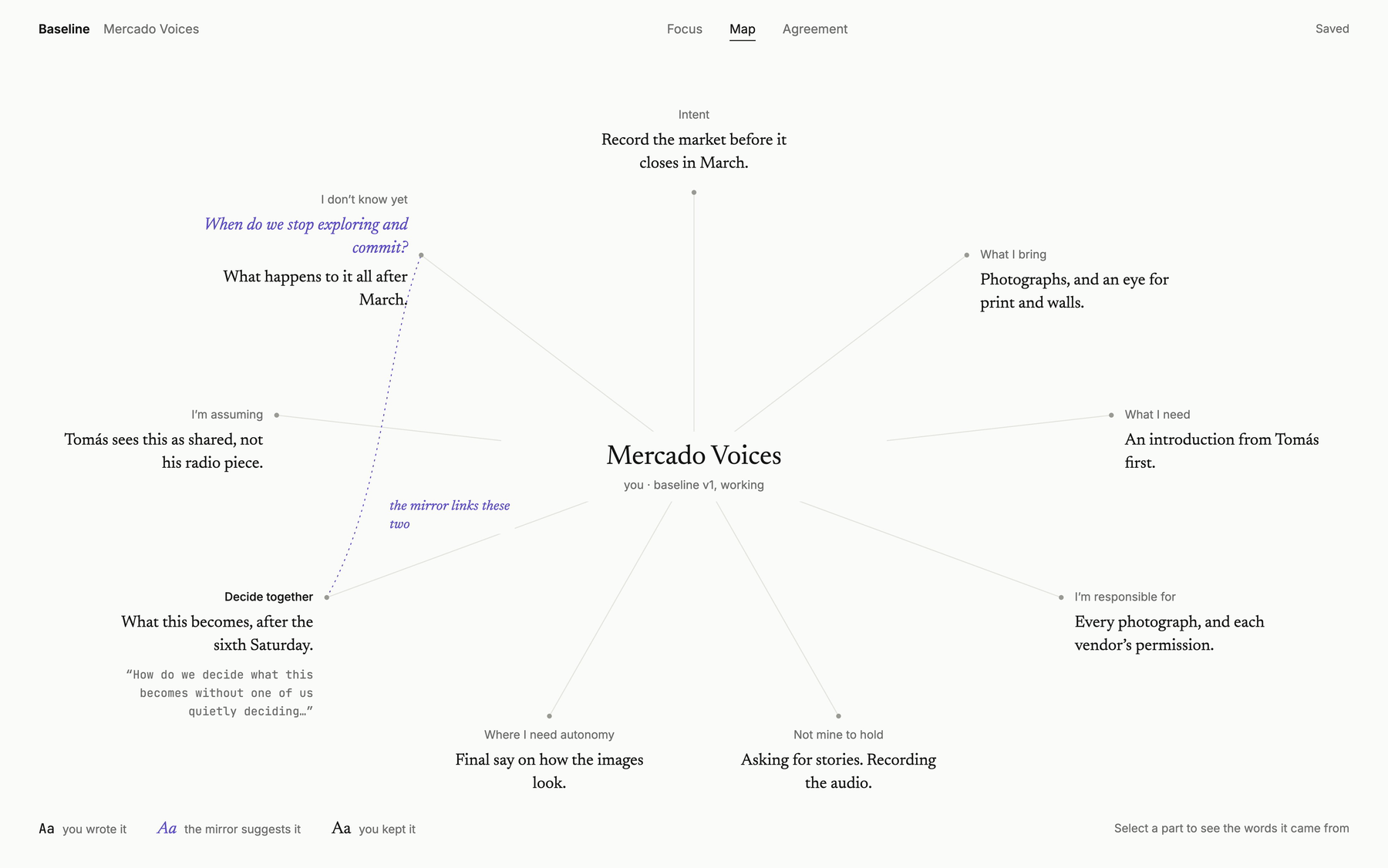
Writing in Focus carries zero upfront structure. From those raw entries, Baseline proposes a spatial map across nine dimensions: intent, what you bring, needs, boundaries, autonomy, joint decisions, assumptions, and open unknowns.

In the Mercado Voices prototype, a passage about a creative collaboration surfaces a tension between wanting freedom to explore and needing clearer commitments. You can trace that suggestion back to the exact sentence, rewrite it, keep it, or dismiss it—the map stays linked to the journal rather than replacing it.

VISUAL 03 · JOURNAL → MAP 03 · WRITTEN → NOTICED → MAPPED
Diagram showing raw journal text on the left linked by fine curves to a radial spatial map of Mercado Voices on the right across Written, Noticed, and Mapped stages
The journal opens into a map: phrases lift out of your writing and find their place across nine axes of meaning while provenance lines keep every mapped element traceable to its source passage.
(04)

The moment in between

Designing the moment between suggestion and understanding.

The hardest interaction to get right happens the moment the mirror notices something. Selecting a passage opens a compact action bar right beside the text rather than pulling you into a separate chat sidebar, while the mirror places its reading in the margin:

“There may be a tension between your desire to explore and your need for clearer commitments.”

From there you can inspect the source quote, edit the phrasing, promote it, or dismiss it. Three typographic and visual states keep authorship unmistakable at every step:

State 01 · Source What I wrote.

The original human expression—preserved untouched in the journal.

State 02 · Provisional What AI noticed.

A proposed interpretation, with its source passage visible and editable.

State 03 · Confirmed What I chose to keep.

An explicitly reviewed understanding promoted into the map or Baseline.

VISUAL 04 · SIGNATURE INTERACTION 04 · SELECTION & MARGIN MIRROR
Baseline v2 contextual text selection toolbar offering Reflect, Ask the mirror, and Keep as a statement, linked by a violet curve to a margin mirror reflection with Write about this, Keep as a statement, and Dismiss actions
Select your own words, and the mirror answers beside them—never in your voice. Contextual actions let you reflect, ask the mirror, keep as a statement, or dismiss without opening a chatbot sidebar.
(05)

Three representations

Three representations of the same thinking.

I began exploring three complementary modes of interaction.

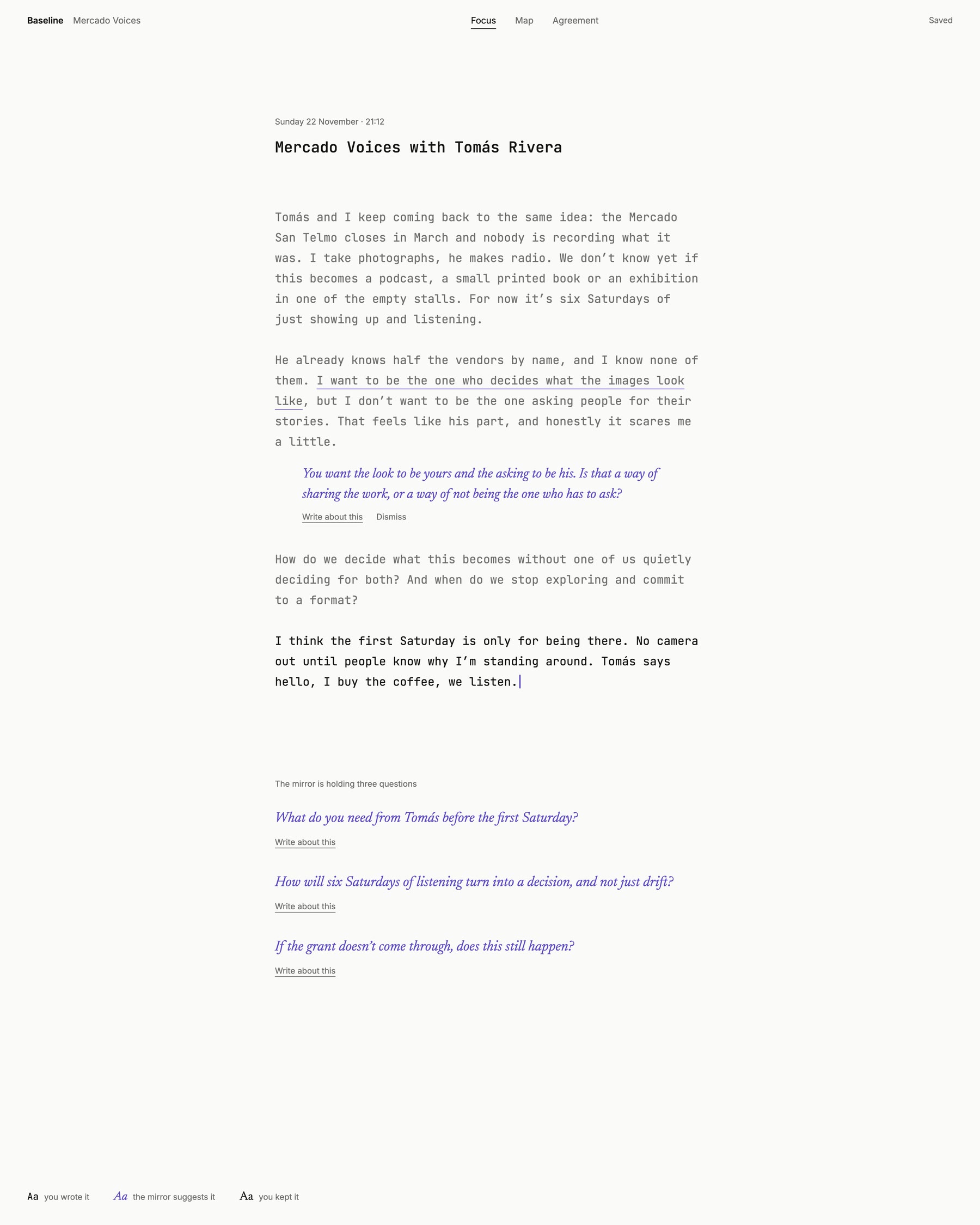
Focus — a place to write

A quiet, editorial writing surface that makes it easy to express unfinished thoughts. AI remains contextual rather than constantly present. The interface prioritizes reading, writing, and concentration.

Map — a place to see relationships

Ideas from different entries can be brought together. The map helps someone explore connections, contradictions, recurring concerns, and unresolved questions. It is deliberately provisional. Connections can be questioned, reorganized, and removed.

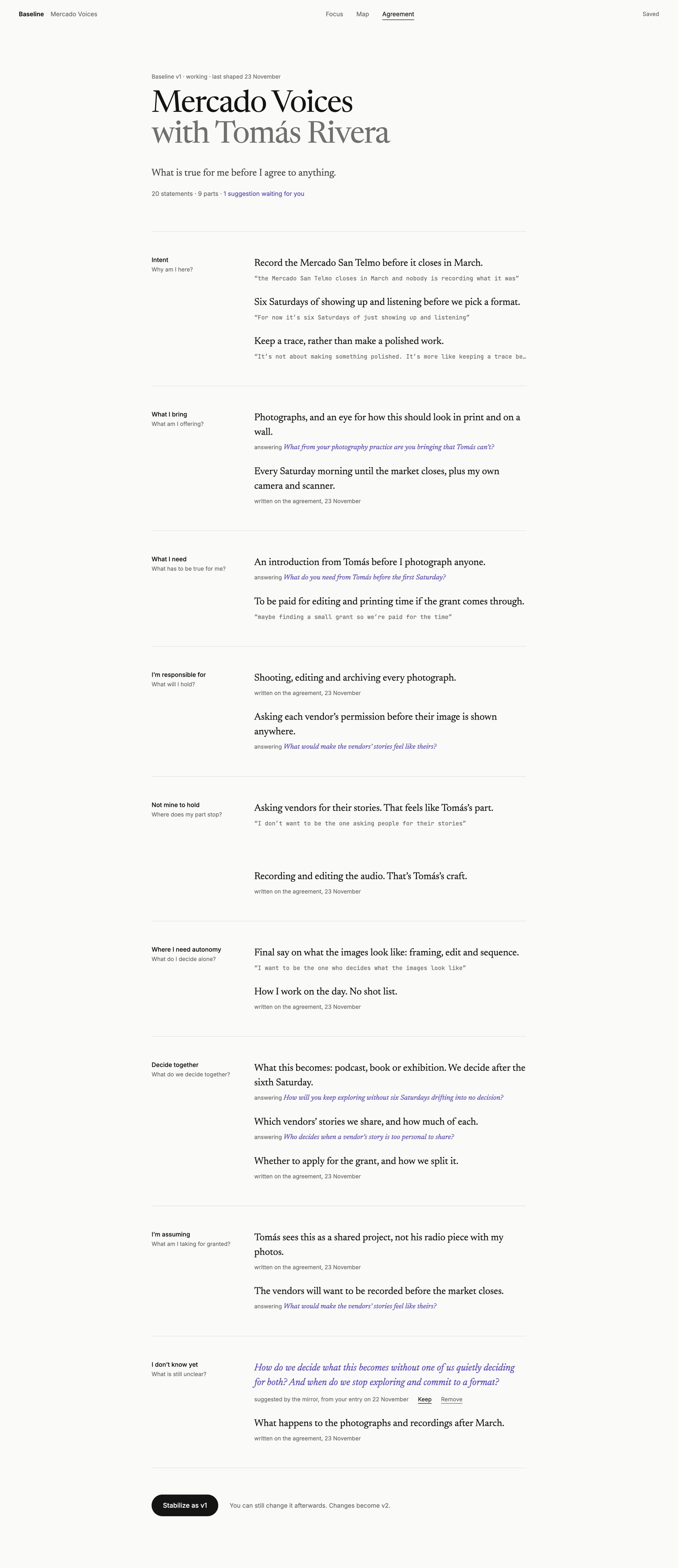
Baseline — a place to establish understanding

At some point, an observation becomes something the person is prepared to stand by. A Baseline collects these deliberately confirmed understandings. It might describe the current boundaries of a project, a set of priorities, or what two people have explicitly agreed. Unlike the exploratory map, the Baseline makes the distinction between possibility and commitment visible.

Focus is for expression. Map is for exploration. Baseline is for deliberate confirmation.

VISUAL 05 · THREE MODES 05 · ONE TYPE SYSTEM ACROSS FOCUS, MAP & BASELINE
Baseline v2 three-mode product walkthrough showing Focus, Map, and Baseline side by side using one consistent light-paper typographic system
Full Focus v2 light-paper screen with Mercado Voices writing, inline violet mirror reflection, and open mirror questions
01 · FOCUS Full journal capture with inline mirror reflection & open questions.
Full Map v2 light-paper radial spatial graph with nine axes and violet mirror links
02 · MAP Full 9-axis radial map with violet dotted mirror connections.
Full Baseline v2 agreement document compiling all nine sections down to Stabilize as v1
03 · BASELINE Full 9-part working Baseline document down to Stabilize as v1.
One typographic voice system across Focus, Map, and Baseline—all showing the Mercado Voices with Tomás Rivera project.
(06)

The right to disagree

The interface must preserve the right to disagree.

Fluent AI prose carries false authority. When a tool quietly turns rough notes into clean conclusions, it nudges you to accept a framing you never chose. Separating proposal from confirmation therefore has to live in the UI mechanics themselves: every mirror reading stays visually provisional until you explicitly edit, keep, or remove it.

The same rule applies once two people work toward a shared Baseline. One person’s interpretation stays distinct from the other’s consent, leaving explicit room for disagreements that are still open.

VISUAL 06 · PROPOSED VS CONFIRMED 06 · THE MIRROR PROPOSES, YOU DECIDE
Baseline v2 diagram tracing three journal statements from You wrote to The mirror proposed to You decided, showing Edited, Kept, and Removed outcomes
Nothing becomes the agreement without your hand on it. Tracing three passages from what you wrote, to what the mirror proposed in italic violet, to what you explicitly Edited, Kept, or Removed.
(07)

Across time

Making understanding visible across time.

Positions shift as real work unfolds: an assumption breaks, a boundary hardens, or a settled choice reopens. Baseline records those turns without overwriting earlier history—keeping original journal entries intact, updating relationships in the map, and freezing confirmed Baselines as versioned snapshots (v1 → v2).

Instead of an opaque edit log, you can trace three concrete questions across any project:

What did I believe then? What do I understand now? What changed between them?

VISUAL 07 · LIVING HISTORY STABILIZE AS v1 → CHANGES BECOME v2 · PRESERVING EARLIER UNDERSTANDING
BASELINE v1 · NOV 23 STABILIZED SNAPSHOT DECIDE TOGETHER Format stays open until after the sixth Saturday. ASSUMING A grant may pay for print time. JOURNAL ENTRY · DEC 14 “After Saturday 4, the vendors want prints they can hold—not a podcast. The grant fell through.” HUMAN CONFIRMATION GATE DIFF REVIEWED · v1 PRESERVED BASELINE v2 · DEC 14 CONFIRMED REVISION − Format open until Saturday 6 + Printed booklet + stall wall − Assuming external grant + Self-funded risograph run LINKED TO DEC 14 ENTRY
You can still change a stabilized Baseline afterwards—changes become v2 while preserving what you understood in v1 and which journal entry prompted reconsideration.
(08)

Interaction & engineering

An exploration in interaction and engineering.

Baseline is being developed as a local-first desktop application, with React and Tauri as the application foundation.

The technical challenge is closely connected to the interaction problem. The system needs to distinguish source writing from AI interpretations, exploratory relationships from confirmed understanding, and proposals from authorized changes.

My design exploration includes editorial typography, spatial information design, contextual AI controls, stateful interactions, and history. Moving from v1 (dark UI with status badges) to v2 (warm light paper with three typographic voices) let six tokens carry the entire system—wired through a local Figma plugin so the design file and React prototype read from one source.

Local persistence and immutable version diffs are currently in development; the working desktop prototype already runs the full three-mode Focus, Map, and Baseline workflow.

VISUAL 08 · ITERATION, TOKENS & IMPLEMENTATION v1 DARK → v2 LIGHT · SINGLE-SOURCE TOKENS · REACT + TAURI
Baseline v1 dark interface using status chips and monospace labels
v1 · Earlier Dark chrome, status chips, mono used for UI labels.
Baseline v2 light paper interface using three typographic voices with monospace reserved strictly for human writing
v2 · Current Warm paper, three typographic voices, mono reserved only for you.
SIX TOKENS · ONE SOURCE OF TRUTH A local Figma plugin builds screens and components directly from these tokens so design and prototype never drift.
--saidJetBrains Mono 17/30 #141414
--suggestNewsreader ital 20/30 #5B4BC4
--settledNewsreader 21/31 #141414
--uiInter 12/18 #6B6B6B
--paper#FAFAF8
--rule#E4E4DF
Implemented in Working Prototype

Editorial Focus, Spatial Map & 9-Part Agreement UI

Interactive React desktop shell featuring the v2 warm-paper three-voice typography system, contextual selection mirror reflections, 9-axis radial epistemic graph with violet links, and source-cited working Baseline document.

In Development · Architectural Roadmap

Local-First Persistence, Version Diffs & Multi-Party Consent

Tauri local database persistence, immutable v1 → v2 diff inspection, reliability evals for ambiguous prose, and explicit two-party ratification where one person’s interpretation stays distinct from another’s consent.

// Core epistemic boundary in TypeScript: proposals never mutate confirmed state directly
type SourceSpan = { entryId: string; quote: string; createdAt: string };

type MirrorProposal = {
  id: string;
  axis: BaselineAxis;           // intent | bring | need | hold | notMine | autonomy | joint | assuming | unknown
  status: 'proposed' | 'dismissed';
  origin: 'mirror';
  text: string;
  sources: SourceSpan[];        // mandatory grounding back to human writing
};

type ConfirmedClause = {
  id: string;
  axis: BaselineAxis;
  status: 'kept';
  confirmedBy: 'human';         // only promoted via explicit Keep / Edit transition
  text: string;
  sources: SourceSpan[];
  baselineVersion: number;      // frozen on Stabilize as v1; incoming changes open v2
};
The v2 desktop UI and six-token Figma pipeline are implemented in React; local database persistence and multi-party ratification are in progress.
(09)

What it is teaching me

What this prototype is teaching me.

Building Baseline shifted where I spend design energy on AI products. Better prompts matter far less than the visual and state boundaries around model output: how a suggestion enters the margin, how quickly you can inspect its source sentence, how easy it is to reject, and how the app preserves what you believed a month ago without deciding what you should believe today.

Good thinking tools keep authorship visible—from the first rough sentence to a versioned agreement.

Collaborators
Independent Project
Status
2026 · In development / interaction exploration
My Contribution
Human–AI Interaction, Product Design, Information Architecture, Visual Design, React & Tauri Prototyping